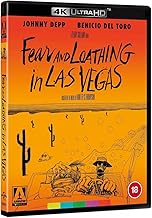
For decades, Fear and Loathing in Las Vegas has stood as a monument to cinematic anarchy, a film that defies easy categorization and continues to captivate audiences with its hallucinatory vision of the American Dream gone wrong. Terry Gilliam's 1998 adaptation of Hunter S. Thompson's seminal work is a challenging, brilliant, and utterly unique piece of filmmaking. Now, with the release of the Fear and Loathing in Las Vegas [4K UHD] from Arrow Video, fans and newcomers alike have the opportunity to experience this cult classic in unprecedented detail and clarity. This isn't just another re-release; it's a definitive presentation that honors the film's chaotic spirit with meticulous technical care.
Understanding the enduring appeal of Fear and Loathing requires a look back at its origins. Hunter S. Thompson's "gonzo journalism" was a literary revolution, blending fact and fiction, reportage and personal rant into a new form of storytelling. The book, a savage satire of the death of the 1960s counterculture, seemed unfilmable. Enter Terry Gilliam, a director whose own visual sensibilities—baroque, cluttered, and dreamlike—were a perfect, if unexpected, match for Thompson's prose. The resulting film, starring Johnny Depp as Raoul Duke and Benicio Del Toro as Dr. Gonzo, polarized critics upon release but has since been rightly recognized as a visionary work that captures the book's essence through its own cinematic language.
Why the Arrow Video 4K UHD Release is a Game-Changer
The new 4K UHD edition from Arrow Video represents the pinnacle of home video presentation for this film. Arrow is renowned among collectors for its dedication to film restoration and exhaustive special editions, and their treatment of Fear and Loathing in Las Vegas is no exception. The 4K scan and restoration, supervised by director Terry Gilliam, brings a revelatory level of detail to the film's intentionally garish and hyper-saturated visuals. The neon signs of the Las Vegas strip, the intricate patterns of Duke's drug-addled hallucinations, and the gritty texture of the desert landscape are presented with stunning clarity. This visual upgrade is crucial because the film's power is so deeply tied to its aesthetic—a carefully constructed chaos that demands to be seen in the best possible quality.
A Deep Dive into the Special Edition Features
Beyond the stunning 4K picture, this special edition is packed with supplemental material that provides immense context and insight. For scholars and fans, these features are invaluable. They include new and archival interviews with Terry Gilliam, Johnny Depp, and producer Laila Nabulsi, offering firsthand accounts of the film's tumultuous production. Documentaries explore Hunter S. Thompson's life and the art of gonzo journalism, helping viewers understand the cultural bedrock from which the film sprang. Perhaps most fascinating are the deleted scenes and alternate takes, which showcase Gilliam's editorial process and the many directions this unorthodox project could have taken. This wealth of material doesn't just accompany the film; it enriches the viewing experience, turning a single watch into a comprehensive study.
The Enduring Legacy of a Cult Classic
What is it about Fear and Loathing in Las Vegas that has cemented its status as a cult classic? The answer lies in its fearless authenticity and its refusal to offer easy answers. It is not a film about the fun of drug use, but rather a terrifying and often hilarious portrait of its consequences—paranoia, despair, and the search for meaning in a plastic paradise. Its critique of American consumerism, political hypocrisy, and the failure of the hippie dream remains painfully relevant. The characters of Duke and Gonzo are not heroes but tragicomic anti-heroes, lost souls careening through a landscape they helped create but can no longer understand. This complexity, presented without moralizing, invites repeated viewings and passionate debate.
Terry Gilliam's Vision and Hunter S. Thompson's Spirit
The collaboration between director Terry Gilliam and the spirit of Hunter S. Thompson (who was heavily involved during pre-production) resulted in a film that is both a faithful adaptation and a distinct creative work. Gilliam didn't try to literally translate the book to screen; instead, he internalized its tone and created a visual equivalent. The frantic camera work, the distorted sets, and the impeccable production design all serve to place the audience directly inside Duke's subjective, chemically-altered experience. Watching the film in this new 4K UHD format allows viewers to appreciate the staggering amount of detail in every frame—from the props in the hotel room to the costumes—that Gilliam and his team used to build this unforgettable world. It's a testament to auteur-driven filmmaking at its most daring.
Is This the Ultimate Release for Collectors?
For the home video collector, the question is always whether an upgrade is justified. In the case of Arrow Video's Fear and Loathing in Las Vegas 4K UHD, the answer is a resounding yes. This release supersedes all previous Blu-ray editions in both audiovisual quality and supplemental content. The HDR grading brings out the depth of the film's color palette in a way standard dynamic range cannot, making the surreal sequences more immersive and the bleak moments more stark. The uncompressed audio ensures that the film's iconic soundtrack—featuring everything from Tom Jones to Jefferson Airplane—sounds crisp and powerful. Combined with the robust, book-style packaging and illustrated collector's booklet featuring new writing on the film, this set is designed to be the centerpiece of any serious collection of contemporary cinema.
In conclusion, Fear and Loathing in Las Vegas is more than a movie; it's a cultural artifact, a warning, and a celebration of artistic rebellion. Arrow Video's 4K UHD release does justice to this legacy. It provides the technical presentation the film's visuals deserve and surrounds it with context that deepens our understanding. Whether you're a longtime fan seeking the definitive viewing experience or a curious newcomer ready to take the trip, this edition is the perfect vehicle. It confirms the film's place not just as a relic of the 90s, but as a timeless, chaotic, and essential piece of American filmmaking that continues to ask uncomfortable questions about who we are and what we're searching for in the neon desert of modern life.


![Fear and Loathing in Las Vegas [DVD]](https://m.media-amazon.com/images/I/91RZMbnPpyL._AC_UY218_.jpg)
![Fear and Loathing in Las Vegas (The Criterion Collection) [4K UHD]](https://m.media-amazon.com/images/I/815Dxqc0X7L._AC_UY218_.jpg)
![Fear and Loathing in Las Vegas [Blu-ray]](https://m.media-amazon.com/images/I/71kZZqdD57L._AC_UY218_.jpg)
![Fear and Loathing in Las Vegas (The Criterion Collection) [Blu-ray]](https://m.media-amazon.com/images/I/81h7QOrWU6L._AC_UY218_.jpg)


